
Iliotibial band syndrome has a signature that makes it one of the more recognisable running injuries: pain on the outside of the knee that appears at a remarkably consistent point in a run, then eases soon after stopping.
If you can predict roughly which kilometre your knee will start hurting, this is likely what you're dealing with.
What the ITB is — and isn't
The iliotibial band is a thick band of connective tissue running down the outside of the thigh, from the hip to just below the knee. It's not a muscle, and it's not a structure that stretches meaningfully — it's dense, strong, and firmly anchored along the length of the femur.
That single fact explains why the most common self-treatment doesn't deliver lasting results.
Pain arises from compression and irritation of the tissue between the ITB and the bony prominence on the outside of the knee, particularly around 30 degrees of knee flexion — which happens to be roughly where the knee sits during the loading phase of running.
Why it happens
The usual contributors are:
- Training load — increases in volume, and particularly downhill running, which loads the outer knee most
- Hip abductor weakness — when the gluteal muscles don't control the hip and pelvis well during single-leg stance, the mechanics at the outer knee change
- Running mechanics — a narrow stride where the foot crosses toward the midline increases compression at the outer knee
- Cambered surfaces — consistently running on the same side of a sloped road creates asymmetric loading
- Rapid return after time off — reintroducing volume faster than the hip's control can support
Why foam rolling isn't the answer
Foam rolling the ITB is close to universal among runners, and it can feel like it helps in the moment — largely through effects on pain perception rather than any change to the tissue itself.
But because the ITB cannot be lengthened by rolling, the underlying situation is unchanged. Runners who roll diligently and change nothing else typically find the pain returns at the same point in the same run.
Roll if it's comfortable. Just don't expect it to be the treatment.
What actually works
Effective management addresses the load and the control, not the band:
- Hip and gluteal strengthening — particularly the muscles controlling hip abduction and rotation, which is the most consistently effective element of ITB rehabilitation
- Load management — temporarily reducing distance to below your symptom threshold, and avoiding downhill running while symptoms settle
- Running retraining — increasing step width where a narrow stride is contributing, and often a modest cadence increase
- Surface variation — avoiding repeatedly running the same camber
- Graded return — rebuilding distance progressively once symptoms settle
Because ITB syndrome is so closely tied to mechanics, 3D running gait analysis is often particularly useful here, measuring stride width, hip control and knee position rather than estimating them by eye.
What recovery looks like
Most runners improve within six to eight weeks with consistent strengthening and sensible load management. The characteristic pattern of recovery is that the distance at which pain appears gets progressively further out — a useful way to track whether your program is working.
If outer knee pain is capping your distance, our running physiotherapy team assesses and treats runners across the Sutherland Shire.
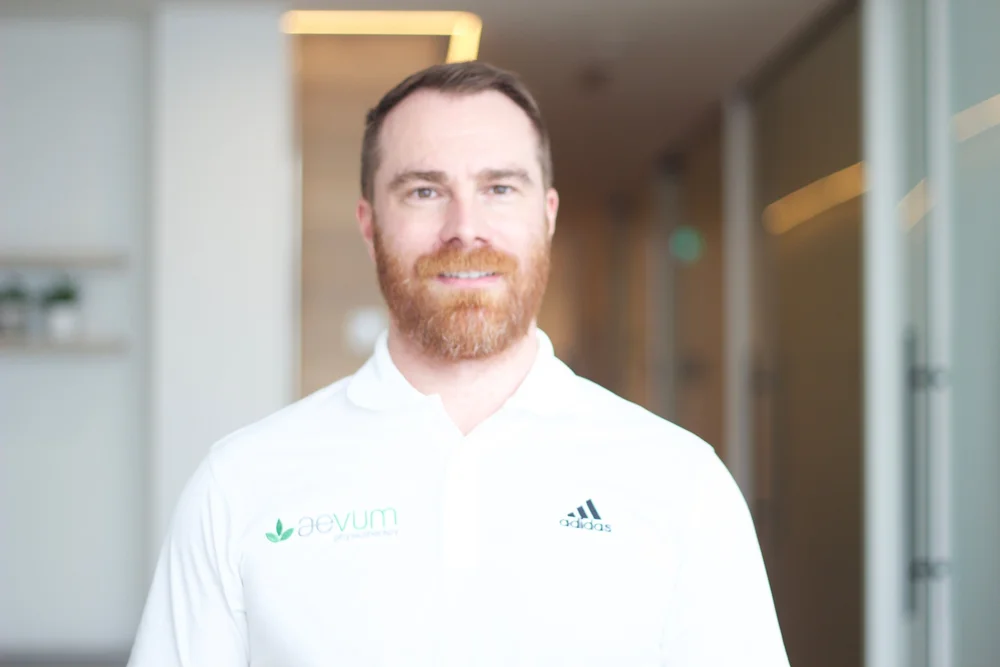
Written by Aaron Babb, MAppSc Physiotherapy — Founder & Director, Aevum Health & Physiotherapy.
Dealing with a running injury, or want to run more efficiently? Our running physiotherapy team assesses runners of every level across the Sutherland Shire.
Running physiotherapy →