
Pain around the front of the knee is the most common running complaint we see. Its formal name is patellofemoral pain syndrome; most runners know it as runner's knee. The good news is that it's rarely a sign of damage — and it responds well to the right approach.
The frustrating news is that the most intuitive treatment, rest, is usually the least effective on its own.
What runner's knee actually is
Runner's knee describes pain arising from the joint between the kneecap (patella) and the thigh bone (femur). Every time you bend and straighten your knee, the kneecap glides through a groove at the end of the femur. Running loads that interface heavily and repeatedly.
Pain develops when the load passing through the joint exceeds what the surrounding structures can comfortably tolerate. Note the framing: it's a capacity problem far more often than a damage problem. That distinction shapes everything about treatment.
How it presents
Typical features include:
- A dull ache around or behind the kneecap, often hard to point to precisely
- Pain that worsens with running, especially downhill
- Discomfort going down stairs
- Aching after sitting for long periods with the knee bent — sometimes called the "theatre sign"
- Pain with squatting or deep knee bending
- Occasionally, a grinding or clicking sensation, which on its own isn't a cause for concern
Why it happens
Several factors typically combine:
- Training load spikes — the most common single driver, particularly rapid increases in volume, hill work or speed sessions
- Hip and gluteal weakness — when the muscles controlling the hip don't stabilise the thigh well, the knee absorbs more load
- Quadriceps capacity — an under-conditioned quadriceps transmits more force through the joint
- Running mechanics — cadence, stride length and how the knee tracks during stance all influence loading
- Footwear and surface changes — altering how force reaches the knee
Notice that most of these are modifiable. That's why the prognosis is generally good.
Why rest alone doesn't work
Rest reduces load, so the pain settles. But it also further reduces the strength and capacity of the very structures that were struggling. When you resume running at your previous volume, the mismatch between load and capacity is now wider, and the pain returns — often sooner.
This is the cycle we most often see in runners who've had recurring knee pain for months or years: rest, feel better, return, hurt again.
Breaking it requires building capacity, not just removing load.
How physiotherapy treats runner's knee
Treatment follows the assessment, but a typical program includes:
- Load management, not shutdown — adjusting volume and intensity so symptoms settle while you keep running where possible
- Progressive hip and gluteal strengthening — among the most consistently effective interventions for patellofemoral pain
- Quadriceps strengthening — building the knee's capacity to handle running load
- Running retraining — small increases in cadence, in particular, can meaningfully reduce load through the patellofemoral joint
- Graded return to full training — structured so capacity keeps pace with load
Where symptoms have been stubborn or recurrent, 3D running gait analysis can identify the specific loading pattern behind your case rather than treating it generically.
What recovery looks like
Most runners feel meaningful improvement within six to twelve weeks of consistent strengthening. Progress is rarely linear — some weeks are better than others — and that's normal. The measure that matters is the trend across weeks, not day to day.
If knee pain is limiting your running, our running physiotherapy service assesses and treats runners throughout the Sutherland Shire.
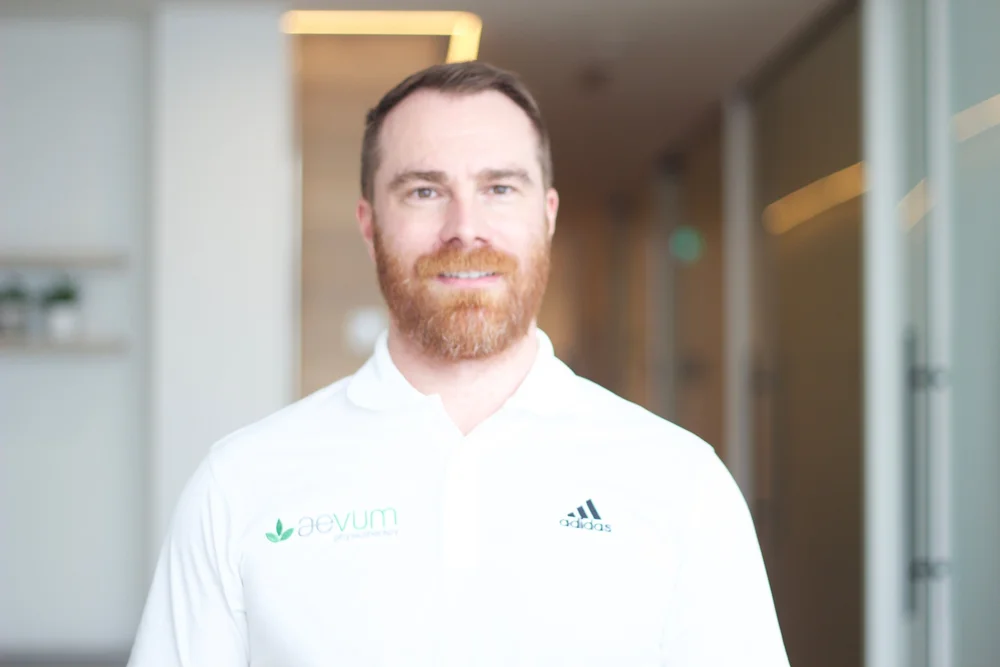
Written by Aaron Babb, MAppSc Physiotherapy — Founder & Director, Aevum Health & Physiotherapy.
Dealing with a running injury, or want to run more efficiently? Our running physiotherapy team assesses runners of every level across the Sutherland Shire.
Running physiotherapy →